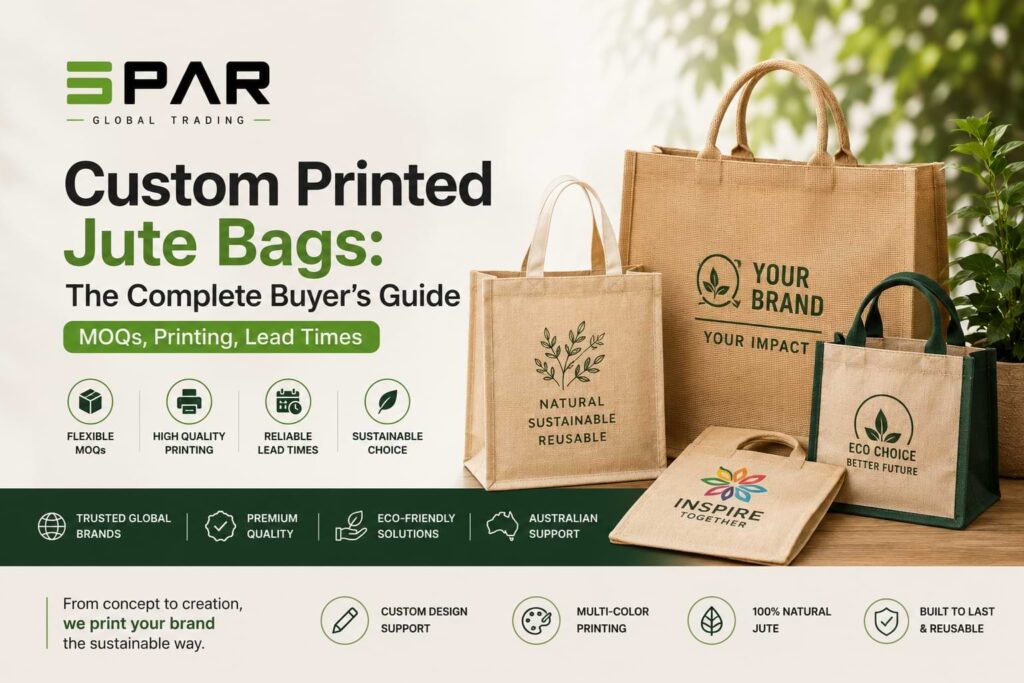
Custom printed jute bags are ordered in bulk, typically from around 500-1,000 units, screen printed with your logo, and delivered in Australia roughly 10-16 weeks after artwork approval. Price depends on size, handles, lamination, and print colours. Sampling before production is standard practice, and landed cost, not unit price, is the number to compare.
he essentials before we go deeper:
- Typical minimums: around 500-1,000 units for standard bags with custom printing; fully bespoke sizes usually start higher
- Typical production time: 4-8 weeks after sample approval, depending on order size and season
- Typical sea freight to Australia: 3-5 weeks port to port, plus customs clearance and delivery
- Best print results: bold logos in 1-3 colours on natural jute; full colour is possible on laminated surfaces or cotton panels
- Always sample first: a physical pre-production sample protects you before the bulk run
- Compare landed cost: unit price plus freight, duties, and charges delivered to your door, not the ex-factory sticker
Every figure above is an industry-typical range; your exact minimums, timings, and pricing are confirmed at quote stage against your specific design. Now, the details that first-time bulk buyers actually worry about.
What You Can Customise
A custom jute bag is built from decisions, and each one shapes both the price and the result. Here is the full menu.
Size and shape. Standard shopper, wine bag, conference tote, or beach bag formats keep minimums lower, while fully bespoke dimensions are possible at higher volumes. A gusset, the panel that gives the bag depth at the sides and base, is what lets a jute bag stand upright and swallow a grocery run.
Handles. Padded rope handles are the jute classic, comfortable under heavy loads. Cotton webbing handles suit a cleaner look, and you can specify short grab handles, long shoulder-length straps, or both.
Lining and lamination. An inner laminate adds structure and a wipe-clean surface, while unlaminated jute keeps the bag fully biodegradable. Neither is wrong; it depends on the use case, and we walk through the sustainability trade-off honestly in our guide to whether jute bags are truly eco-friendly.
Fabric and finish. Natural golden jute is the signature look, but dyed fabric, juco (a smoother jute-cotton blend), or a sewn cotton front panel are all options when your artwork needs a finer surface.
Extras. Internal pockets, base boards, closures such as velcro or buttons, woven labels, and hang tags can all be specified, and even the bulk packaging can be arranged plastic-free.
Print Methods for Jute: What Your Logo Will Actually Look Like
Jute’s open weave is part of its charm, and it rewards the right print method. Here is how the options compare.
| Print method | Best for | Colour capability | How it looks | Watch-outs |
|---|---|---|---|---|
| Screen printing | Logos and text; most orders | 1-3 spot colours | Bold, matte, sits into the weave naturally | Fine detail and small text can break up on coarse fabric |
| Transfer printing | Photographic or gradient artwork | Full colour | Crisp and vivid | Needs a laminated surface or cotton panel to shine |
| Printing on a cotton panel | Detailed artwork on a natural jute body | Full colour | Smooth print zone framed by jute texture | Adds a sewing step and slightly higher cost |
| Embroidery | Premium branding accents | Multi-colour thread | Tactile, high-end | Suited to smaller logo areas; higher cost per unit |
Two practical truths from the orders we manage. First, the golden base tint warms every colour printed on it, so whites print softer and pale colours shift slightly; a white underbase or a panel solves this when exact brand colours are critical. Second, artwork designed for jute performs better than artwork adapted to it: bold shapes, clean lines, and minimum text sizes survive the weave, while hairline detail disappears.
Artwork checklist: supply vector files (AI, EPS, or PDF) with fonts outlined, specify your colours (Pantone references help, with the caveat that matching on natural fibre is close rather than laboratory-exact), and tell us where on the bag the print sits. If you only have a JPEG or PNG logo, we can usually have it redrawn as a vector.
Typical MOQs and How Pricing Scales
Minimum order quantities exist because each custom run requires screen setup, fabric cutting, and a dedicated production slot. As a rule of thumb, standard bag formats with custom printing start around 500-1,000 units, while bespoke sizes, dyed fabric, or multi-position printing usually start higher. Exact minimums depend on the design and are confirmed when we quote.
Pricing scales on a handful of levers, and knowing them lets you steer the quote:
- Quantity: unit prices step down meaningfully at volume breaks, so 2,000 units often costs far less than twice 1,000
- Size and fabric weight: more fabric, more cost, in any fibre
- Handles and extras: padded handles, pockets, closures, and base boards each add a little
- Lamination: adds cost and changes the end-of-life story
- Print colours and positions: each colour is a separate screen, and each printed side is a separate pass
- Dyeing: coloured fabric costs more than natural golden jute
Then there is the number that actually matters: landed cost. That is the unit price plus sea freight, insurance, any applicable duties, GST, and port and delivery charges, calculated to your door. Two quotes with identical unit prices can land very differently, which is why every SPAR quote is built to show the delivered picture rather than a flattering ex-factory figure. For how jute pricing compares with cotton and canvas at volume, see our bag materials comparison guide.
Sampling and Approval: The Step That Protects You
No bulk order should ever be the first time you see your bag. The standard process runs in two stages.
Digital proof first. Before anything physical is made, you approve an artwork mockup showing print size, position, and colours on your chosen bag. This catches layout issues while they cost nothing.
Physical pre-production sample second. A real bag, in your fabric, with your print, in your hands. Check the fabric weight, handle comfort, stitching, print sharpness, and colour in daylight. Sample fees are common in the industry and are typically credited back against the bulk order.
Only after you approve the sample does production begin, and that approved sample becomes the quality benchmark. At SPAR, the bulk order is then inspected against it before shipping: stitching, handle attachment strength, print registration, sizing tolerance, and cleanliness. That inspection is the quality check stage of our process, and it is the difference between discovering a problem in Bangladesh and discovering it in your stockroom.
Lead Times and Shipping to Australia
Custom jute bags are made to order and travel by sea, so the calendar is the one constraint money cannot fully solve. A realistic timeline looks like this:
- Quoting and sourcing: a few days to lock specification and price
- Sampling: typically 1-2 weeks, plus your approval time
- Production: typically 4-8 weeks after sample approval, depending on quantity and factory season
- Sea freight: typically 3-5 weeks from Bangladesh to Australian ports
- Clearance and delivery: customs, port handling, and transport to your door
Door to door, most custom orders land roughly 10-16 weeks after artwork approval. The practical advice we give every client: work backwards from your campaign, event, or season launch and start the conversation 3-4 months out. Peak shipping seasons and public holidays in the production calendar can stretch timelines, and rushing compresses exactly the steps, sampling and inspection, that protect you. We manage the freight, customs, and documentation legs as part of how we work, so tracking the order is our job rather than yours.
Buying Through a Two-Way Trade Partner vs Direct From a Factory
You can absolutely order jute bags directly from an overseas factory, and the sticker price will look attractive. Here is the honest comparison.
Going direct means you take on supplier vetting from a directory listing, communication across timezones and language, upfront payment to a business you cannot visit, quality checking you cannot perform, and a freight and customs process you may be running for the first time. When something goes wrong, and with a first order it sometimes does, your recourse is an email thread.
A sourcing partner exists to absorb exactly those risks. SPAR works with jute makers in Bangladesh we know through long-standing two-way trade relationships, not directory searches. You deal with one Australian-facing point of contact, your order is inspected before it ships, and the logistics chain is handled end to end: sourced, customised, quality checked, shipped, delivered.
Yes, a partner’s quote includes a margin. What it buys is vetted production, accountability, and your time back. For most businesses ordering thousands of dollars of branded stock, that is the cheapest insurance available.
How to Get a Quote
A fast, accurate quote starts with a clear brief. Send us:
- Quantity, or the range you are weighing up
- Bag purpose or size, such as grocery shopper, wine bag, or conference tote
- Handle preference and whether you want lamination
- Print colours and positions, with your logo file attached (vector if you have it)
- Delivery location in Australia
- Your deadline, so we can confirm the timeline honestly before you commit
From there we come back with options, a delivered cost, and a realistic schedule. You can browse formats and finishes on our jute and cotton bags page first if you are still shaping the idea.
Questions First-Time Buyers Ask
“What is the minimum order for custom printed jute bags?” Typically around 500-1,000 units for standard formats, with bespoke designs starting higher. Tell us your quantity and design and we will confirm the exact minimum in the quote.
“Can you print a full-colour design or photo on jute?” Yes, on a laminated surface or a sewn cotton panel. On raw natural jute, bold artwork in 1-3 colours gives the sharpest result.
“How long until the bags are in my hands in Australia?” Plan for roughly 10-16 weeks from artwork approval, covering sampling, production, and sea freight. Start 3-4 months before your launch date for comfort.
“Do I see a sample before the full order?” Always. You approve a digital proof, then a physical pre-production sample, and the bulk run is inspected against that approved sample before shipping.
“What logo file do you need?” A vector file (AI, EPS, or PDF) with fonts outlined is ideal. If you only have a PNG or JPEG, we can usually arrange for it to be redrawn.
Ready to put your brand on a bag worth keeping? Request a sourcing quote with your artwork and quantities, and we will handle the rest end to end.