
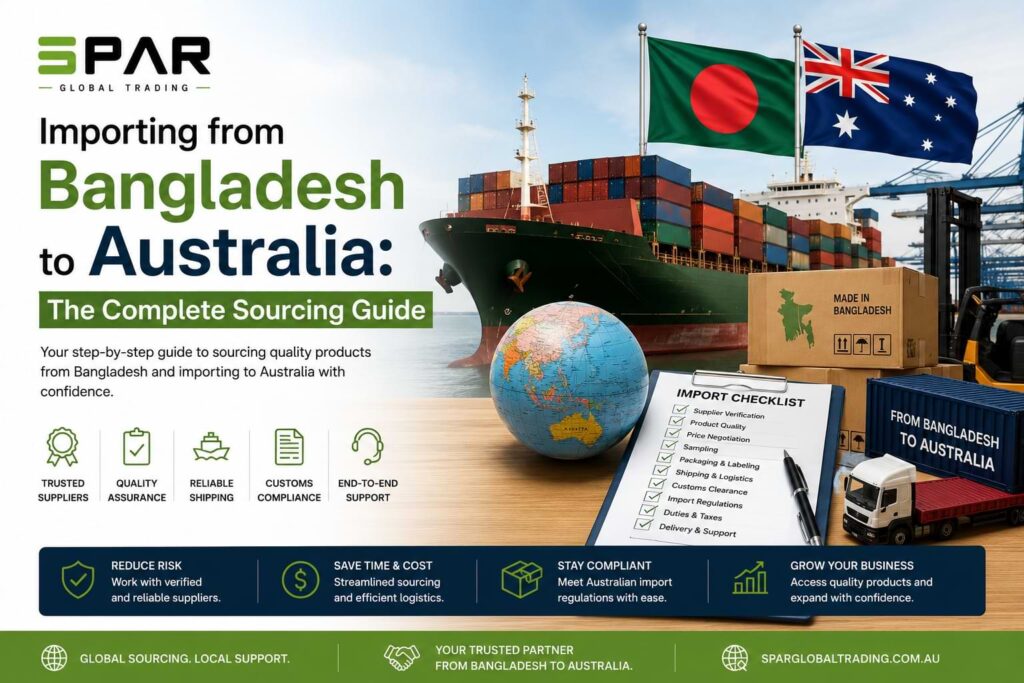
Importing from Bangladesh to Australia means tapping one of the world’s great manufacturing bases: the global capital of jute and one of the largest garment exporters on earth. You can source direct from factories or through a sourcing partner. Direct looks cheaper on paper; a partner with on-the-ground relationships absorbs the verification, quality, and logistics risks that direct buyers carry alone.
Why Bangladesh belongs on an Australian buyer’s map:
- A garment export industry worth around US$47 billion, second only to China by most measures
- The world’s leading exporter of raw jute and jute goods, the fibre behind the reusable bag boom
- More LEED-certified green garment factories than any other country, by widely reported counts, a fact that surprises most first-time buyers
- Scheduled to graduate from UN least developed country status, a milestone that reflects decades of manufacturing-led growth
- A practical planning horizon of 3-4 months door to door for made-to-order goods
- Two Eid holiday periods each year when factories pause, a calendar reality every sourcing plan should respect
We should declare our position early: Bangladesh sourcing is our home ground. SPAR’s trade runs both directions between Australia and Bangladesh, so what follows is the guide we wish every first-time importer had before their first order.
What Bangladesh Manufactures Well
Bangladesh is not a generalist manufacturing destination, and that is its strength. It is world-class in a handful of categories, and those categories happen to map closely onto what Australian businesses buy.
Jute and jute products. This is the one category where Bangladesh is not a contender but the capital. Shopping bags, promotional totes, storage baskets, rugs, and sacking all flow from the country’s spinning mills and artisan workshops, which is why our own jute and cotton bag range is sourced here.
Ready-made garments and workwear. The industry that built modern Bangladesh: knitwear, woven garments, uniforms, and workwear at every volume. The sector has also invested heavily in sustainability, with Bangladesh home to more certified green garment factories than any other country.
Home textiles. Towels, bed linen, and woven homewares are an established export strength, often from the same industrial ecosystem as garments.
Leather goods and footwear. A growing category spanning bags, small leather goods, and shoes, increasingly compliance-focused as the industry matures.
That maturation is the wider story. Bangladesh is scheduled to graduate from the UN’s least developed country category, a status change earned by sustained growth, and whatever the final timing, the direction is a manufacturing base becoming more capable, more compliant, and more competitive.
Direct Sourcing vs a Sourcing Partner: The Honest Comparison
| Factor | Going direct | Through a sourcing partner |
|---|---|---|
| Sticker price | Lower ex-factory quote | Includes a partner margin |
| Supplier verification | Your research, from a distance | Vetted factories, known first-hand |
| Quality control | Photos and promises, unless you fly in | Inspection at origin before shipping |
| Communication | Timezones, language gaps, sales staff | One accountable, Australia-facing contact |
| Freight and customs | Your first-time learning curve | Managed end to end, documents included |
| Recourse when something is wrong | An email thread | A partner whose business depends on fixing it |
| Your time | Substantial, ongoing | A brief and an approval |
The honest read: going direct genuinely suits experienced importers with volume, sourcing staff, and the ability to visit factories. For everyone else, the partner margin is not an added cost so much as a transfer of risk, and on a first order into a new country, risk is the expensive part.
The Risks Nobody Mentions
Most sourcing guides stop at “find a supplier and negotiate.” These are the four risks that actually decide outcomes.
Verification. Online directories are full of polished profiles, and some belong to trading companies posing as manufacturers, reselling from factories they do not control. Certificates and photos can be borrowed. The only verification that fully counts is feet on the factory floor, which is precisely what a distant buyer cannot provide.
Quality control. The classic failure is sample-to-bulk drift: a beautiful approved sample followed by a container of something lesser. Once goods are on the water, your leverage is gone. Quality has to be inspected at origin, against the approved sample, before shipment, every time.
Payment. First orders create a standoff: the factory wants security, and you want proof. Never pay 100 percent upfront to an unverified supplier. Structure payments around milestones you can verify, such as sample approval and a passed pre-shipment inspection, so money and evidence move together.
Freight, customs, and biosecurity. Shipments move by sea from Chattogram and need a clean document set: commercial invoice, packing list, bill of lading, and certificates of origin. And here is the Australia-specific detail that catches first-timers: natural-fibre goods such as jute are plant-based products, so Australian biosecurity takes a close interest. Clean, properly treated, and correctly documented goods clear smoothly; poorly prepared ones invite inspection, treatment costs, and delay.
How the Sourcing Process Works, Step by Step
Run well, a Bangladesh sourcing project follows the same eight beats regardless of product:
- Define the specification: product, materials, sizes, quantities, branding, and quality requirements, in writing
- Identify and vet makers, matching the factory’s real capability to your product and volume
- Quote to landed cost, the delivered-to-your-door figure, not the flattering ex-factory one
- Sample and approve, first a digital proof where relevant, then a physical sample that becomes the benchmark
- Production, scheduled around realistic capacity and the holiday calendar
- Pre-shipment inspection against the approved sample and specification
- Ship and clear: freight booking, export documents, Australian customs and biosecurity
- Deliver, with the goods arriving as approved, ready to sell
If that sequence looks familiar, it should: it is how we work formalised into five accountable stages, sourced, customised, quality checked, shipped, delivered.
Costs, Timelines, and What to Prepare
On cost, compare landed, always. The landed cost is the unit price plus sea freight, insurance, clearance, applicable charges, and GST, delivered to your door. Two suppliers with identical unit prices can land far apart, and the cheap-looking quote is often the one hiding its exclusions.
On time, plan a 3-4 month horizon for made-to-order goods: typically 1-2 weeks of sampling, 4-8 weeks of production, and 3-5 weeks of sea freight, plus clearance and delivery. Then respect the calendar: the two Eid festivals pause production each year as workers travel home, and wise buyers schedule around them rather than discovering them.
To prepare, have six things ready before you approach anyone:
- A written specification, or the raw material for one
- Artwork or technical details, if the product is branded or made to design
- Realistic quantities, including whether you expect repeat orders
- A budget framed as landed cost, not unit price
- Your deadline, worked backwards from launch or season
- Your delivery point in Australia
A buyer who arrives with that list gets sharper quotes, faster answers, and noticeably more respect from every factory.
Why Local Relationships Change the Outcome
Everything above can be learned. What cannot be downloaded is the thing that actually moves outcomes in Bangladesh: relationships.
A partner with real local relationships knows which factories deliver and which merely quote, can walk a production floor unannounced, hears about a problem while it is still fixable, and navigates language, business culture, and the rhythm of the year as an insider. Distance buyers get the sales office; relationships get the truth.
Ours run deeper than sourcing alone. Because SPAR trades in both directions, carrying Australian lentils and pulses into Bangladesh even as we bring jute and garments out, we sit inside the market as ongoing partners rather than occasional customers. Relationships compound when trade flows both ways, and our clients inherit that standing on their first order.
That is the model behind our custom sourcing service: tell us what you want to make in Bangladesh, and we run the whole chain, from factory floor to your door, as one accountable process.
Questions First-Time Importers Ask
“What products is Bangladesh best known for manufacturing?”
Jute products above all, where it leads the world, plus ready-made garments and workwear at global scale, home textiles, and a growing leather and footwear sector.
“Do I need a sourcing agent to buy from Bangladesh?”
No, and experienced importers with volume and local access often go direct. A sourcing partner exists for everyone else, replacing verification trips, quality inspection, and logistics management with a single accountable relationship.
“How long does importing from Bangladesh to Australia take?”
Plan 3-4 months door to door for made-to-order goods, covering sampling, production, and sea freight. Add buffer around the two Eid holiday periods, when factories close.
“Is it safe to pay a Bangladeshi supplier upfront?”
Not in full, and not to an unverified supplier. Stage payments against verifiable milestones such as approved samples and a passed pre-shipment inspection, or work through a partner who carries that structure for you.
“What does a sourcing partner actually cost?”
A margin built into your landed quote. What it buys is vetted factories, origin inspection, managed freight, and recourse, which on a first order is the cheapest insurance in the trade.
Thinking about sourcing from Bangladesh?
Tell us what you want to make, and request a quote. One brief, one accountable partner, end to end.