

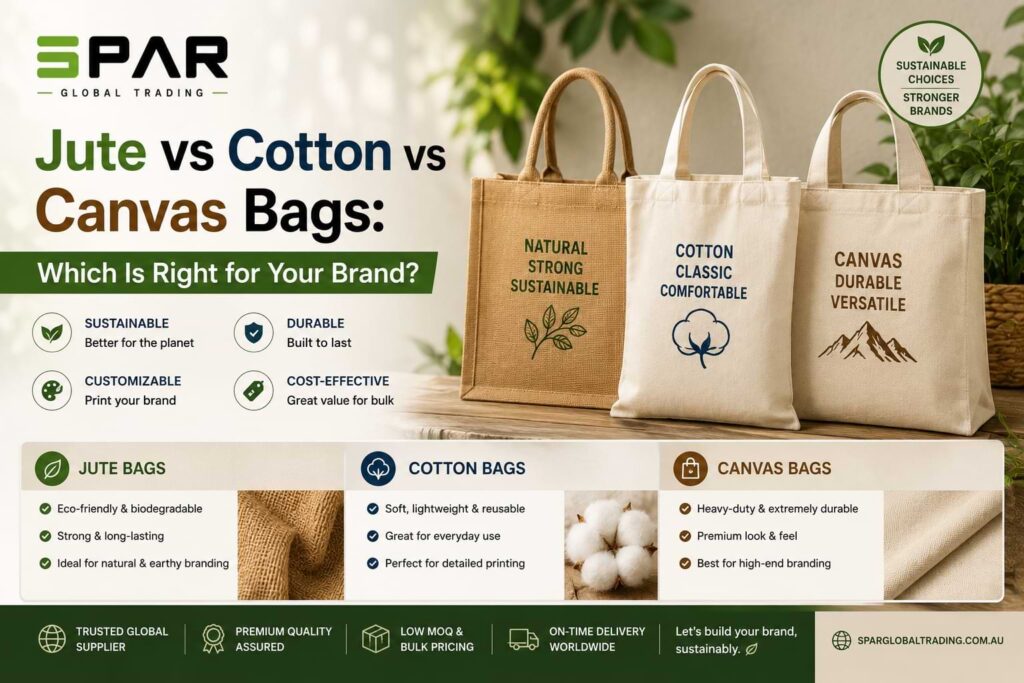
Jute is the best choice for structure, heavy loads, and an instant sustainability story. Cotton offers the smoothest print surface and the lowest unit cost at volume. Canvas, which is simply heavyweight cotton, lasts longest under daily use. The right pick depends on how your customers will actually carry your brand.
Here is the full verdict at a glance, with the detail behind every row further down.
Quick Verdict Table
| Factor | Jute | Cotton (standard) | Canvas (heavy cotton) |
|---|---|---|---|
| Best for | Grocery, hampers, eco brands, conference bags | Retail totes, promo giveaways, fashion | Premium merch, daily-use bags, boutique retail |
| Durability (load and lifespan) | Excellent for heavy loads; 3-4+ years | Good for light loads; sags when overloaded | Outstanding under daily abuse; years of use |
| Structure | Stands upright, holds its shape | Soft, folds flat, packs small | Sturdy but still foldable |
| Print detail | Bold, simple logos work best | Finest detail and full colour | Excellent detail with a premium feel |
| Unit cost at volume | Mid-range | Usually lowest | Usually highest |
| Sustainability story | Strongest; rain-fed, fast-growing, biodegradable | Good if organic; conventional cotton is input-heavy | Same fibre as cotton, more material per bag |
| Care | Spot clean only | Machine washable | Machine washable, may shrink slightly |
| Customer perception | Natural, artisanal, eco-first | Clean, versatile, fashion-friendly | Premium, built to last |
One thing before we go deeper. SPAR supplies both jute and cotton bags, so we have no fibre to push. What follows is the same guidance we give clients on real orders, including the trade-offs a single-material seller would rather skip.
And a clarification that saves a lot of confusion: canvas is not a third fibre. It is cotton woven at a heavier weight, typically 270-400+ gsm compared with 140-180 gsm for a standard cotton tote. Throughout this guide, treat canvas as cotton’s heavy-duty sibling.
Durability and Structure: How Each Bag Handles Real Life
Durability is really two questions. How much can the bag carry, and how long will it survive?
Jute is the load carrier. The fibre is naturally strong with very little stretch, and the stiff weave means a jute bag stands upright and holds its shape with bottles, groceries, or gift hampers inside. Its one weakness is water: jute prefers spot cleaning, and repeated soaking will shorten its life.
Standard cotton is the light-duty option. It is soft, foldable, and machine washable, which makes it easy to live with. But a lightweight tote will sag and stretch if it is regularly loaded like a grocery bag, so match it to lighter contents.
Canvas is the endurance option. The heavy weave shrugs off daily commuting, gym kits, and general abuse, and it actually looks better as it softens with age. In our experience it is the bag most likely to still be in service years after the campaign that created it.
Print Quality and Branding Surface: Where Your Logo Lives
A reusable bag is a walking advertisement, so print quality is not a detail. It is the point.
Cotton takes the finest print. Its smooth, tight surface handles fine lines, small text, and full-colour artwork, and the pale natural or white base shows colours accurately. If your brand relies on detailed artwork, cotton is the safest canvas, no pun intended.
Canvas prints beautifully too. The texture is slightly coarser than standard cotton, but it still carries detailed designs well and adds a premium, substantial feel that suits lifestyle and fashion brands.
Jute asks for bold simplicity. The open, coarse weave swallows fine detail, so strong logos in one or two colours work far better than intricate artwork. The golden background also warms every colour printed on it, which is worth checking against your brand palette.
Two insider options if you want jute’s look with better print fidelity. A sewn-on cotton panel gives you a smooth print zone on a jute body. Or choose juco, a jute-cotton blend fabric that keeps the natural texture while offering a noticeably smoother printing surface. We cover print methods, artwork setup, and what your logo will actually look like in our custom printed jute bags buyer’s guide.
Cost at Wholesale Volumes: What Actually Drives the Price
At typical wholesale quantities, the usual ranking is simple. Standard cotton totes generally cost the least per unit, jute sits in the middle, and heavy canvas costs the most because it simply contains more material.
But the material is only the starting point. Across the orders we quote, these are the factors that move unit price the most:
- Fabric weight (gsm): heavier fabric costs more in any fibre
- Bag size and gusset: bigger bags and boxed bottoms use more fabric and more stitching
- Handles: padded, long, or contrast handles add cost over basic loops
- Lamination and linings: inner coatings add cost and change the sustainability picture
- Print colours and coverage: each additional colour and larger print areas increase price
- Order quantity: unit prices step down meaningfully at higher volumes
The honest advice: compare quotes on identical specifications, not on headline price. A cheap bag that fails in three months is the most expensive bag you can buy, because your brand fails with it.
Sustainability: The Honest Comparison
All three materials beat single-use plastic comfortably, provided the bag is genuinely reused. The differences are in how fast each one earns its footprint back.
Jute reaches break-even fastest. It grows in 4-6 months on monsoon rain, needs minimal pesticides, and biodegrades cleanly at end of life. We unpack the full picture, including the caveats around linings and dyes, in our honest look at whether jute bags are truly eco-friendly.
Cotton depends heavily on how it is grown. Conventional cotton is water and pesticide intensive, and lifecycle studies suggest cotton bags need a high number of reuses to beat single-use plastic on climate impact. Organic cotton improves the story at a higher unit price, and cotton’s washability supports a long working life.
Canvas carries cotton’s footprint at a larger scale, since each bag uses more fibre. Its saving grace is longevity: a canvas bag used daily for years can end up with an excellent footprint per use.
The rule that outranks every material debate: the most sustainable bag is the one your customer keeps using. Design for keepability first.
Customer Perception and Use Cases: What Each Material Says
Customers read materials before they read logos, and each fabric sends a different signal.
Jute says natural and eco-first. The golden texture is instantly recognisable as sustainable, which is why it suits grocers, farmers’ markets, hamper and gift businesses, eco-focused brands, and conference organisers who want their bag kept, not binned.
Cotton says clean and versatile. It is the fabric of bookshop totes, pharmacy bags, fashion promos, and point-of-sale reusables, and it folds small enough to live in a handbag or glovebox.
Canvas says premium and permanent. It suits merch people would happily pay for: streetwear drops, boutique retail, cafes with a loyal following, and any brand that wants its bag carried daily for years.
Which Should You Choose? Scenario-Based Guidance
Choose jute if:
- Your customers will carry groceries, bottles, produce, or hampers
- Sustainability is central to your brand story and you want it visible at a glance
- Your logo is bold and works in one or two colours
- You want a bag that stands upright for retail presentation or gifting
Choose cotton if:
- You need fine print detail, small text, or full-colour artwork
- Unit cost at volume is the deciding factor for a large promo run
- You want a light, foldable bag customers can keep on hand
- Washability matters for your use case, such as food retail
Choose canvas if:
- You are creating premium merch rather than a giveaway
- The bag needs to survive heavy daily use for years
- A substantial, quality feel is part of the brand experience
- Your budget supports a higher unit cost for a longer-lasting impression
Still torn between two? Plenty of brands split the order: jute for in-store and gifting, cotton for events and mailers. There is no rule that says you pick once.
Getting Samples: The Step That Prevents Expensive Mistakes
No comparison guide replaces holding the actual bag. Fabric weight, handle comfort, stitch quality, and how your artwork looks on the real weave can only be judged in hand.
Our advice on every order is the same: sample before you commit. At SPAR, sampling is built into our end-to-end process. We source options to your specification, customise the print, and put every order through quality inspection before anything ships to Australia, with freight and documentation handled for you.
You can explore fabric options, sizes, handles, and finishes across our full jute and cotton bags range.
Questions People Ask About Bag Materials
“Is canvas the same as cotton?”
Essentially, yes. Canvas is cotton woven at a much heavier weight, which is why it is more durable and more expensive than a standard cotton tote.
“Which bag material lasts the longest?”
Canvas typically wins for daily wear and tear, while jute wins for carrying heavy loads without losing shape. Either can serve for years if the stitching and handles are well made.
“Can jute bags be machine washed?”
No, jute should be spot cleaned with a damp cloth and air dried. If machine washability matters for your use case, choose cotton or canvas instead.
“What is a juco bag?”
Juco is a blended fabric of jute and cotton, usually majority jute. It keeps the natural jute look while giving a smoother surface that prints more detailed artwork cleanly.
“Which material is cheapest to brand in bulk?”
Usually standard cotton, thanks to its lower fabric cost and easy printing. Just remember that size, handles, print colours, and order volume often move the price more than the fibre itself.
Not sure which fits your brand?
Request samples and a quote and we will match the right material, fabric weight, and print method to your brief.