

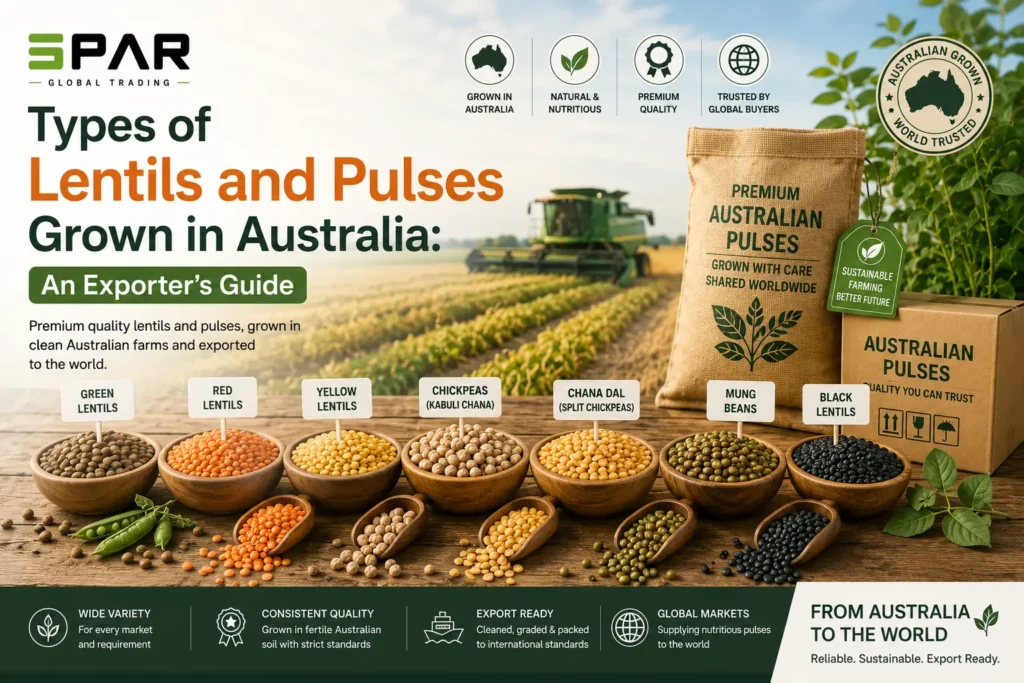
Australia grows four pulses at serious export scale: red lentils, green lentils, chickpeas (mostly desi, some kabuli), and faba beans. Red lentils dominate, feeding South Asia’s dal markets, while chickpeas ship heavily to Bangladesh and Pakistan and faba beans to Egypt. Almost the entire crop is grown for export.
The scale of it, from official trade data:
- Around 4.4 million tonnes: Australia’s total pulse production in a recent peak season, after years of rapid expansion
- 1 to 1.8 million tonnes of lentils grown in recent seasons, overwhelmingly red varieties, with almost all of it exported
- India, Bangladesh, and Sri Lanka are the top destinations for Australian lentils
- Nearly 790,000 tonnes of chickpeas exported in a recent year, with Bangladesh the single biggest market
- Egypt takes around half of Australia’s faba bean exports by value, feeding the national dish ful medames
- Harvest runs November to December for southern pulses, delivering fresh crop counter-seasonally to northern hemisphere buyers
Plenty of articles list lentil types for home cooks. This one is written from the trade side: what Australia actually grows at scale, who buys each pulse, and what a bulk buyer should specify. It is the same ground we cover with importers every week.
Australia’s Pulse-Growing Regions in Brief
Australian pulses grow in two broad zones, and the split explains the crops.
The southern winter-rainfall zone, covering South Australia’s Yorke Peninsula, Mid North, and Mallee along with Victoria’s Wimmera and Mallee, grows the cool-season pulses: lentils and faba beans, sown into autumn rain and harvested dry in November and December. The northern zone, through northern New South Wales and into Queensland’s Darling Downs, is chickpea country, suited to the crop’s later, warmer season.
In both zones, pulses are rotation crops grown between wheat and barley, fixing nitrogen into the soil as they grow. That rotation logic is why plantings have expanded so quickly: pulses pay twice, once at the silo and once in the following cereal crop.
The Big Four at a Glance
| Pulse | Main growing regions | Harvest window | Key export markets | Typical end uses |
|---|---|---|---|---|
| Red lentils | SA (Yorke Peninsula, Mid North, Mallee), VIC (Wimmera, Mallee) | Nov-Dec | India, Bangladesh, Sri Lanka | Masoor dal, soups, everyday dal dishes |
| Green lentils | Same southern zones, smaller area | Nov-Dec | South Asia, Middle East, Mediterranean | Salads, soups, dishes needing whole texture |
| Chickpeas (desi and kabuli) | Northern NSW, southern QLD | Spring into early summer | Bangladesh, Pakistan, UAE | Chana dal, besan flour, chhola, hummus |
| Faba beans | SA, VIC, southern NSW | Nov-Dec | Egypt, Middle East | Ful medames, falafel, food and feed grades |
Now the detail on each, including what buyers actually specify.
Red Lentils: The Flagship
Red lentils are the centre of the Australian pulse story. They make up the overwhelming majority of lentil plantings, and almost every tonne is grown for export, primarily to the subcontinent where they are eaten as masoor dal.
Quality is the selling point. Southern Australia’s dry harvest finish produces clean, bright, uniform grain with high milling yields, and shipments move as whole red lentils for destination milling or machine-split dal ready for the pot.
Buyers specify closely here, and Australian supply has adapted to match. Bangladeshi buyers, for instance, prefer plump, rounded types known in the trade as football lentils, and Australian varieties and export specs are aligned to exactly that preference. We tell the full story of how Australian red lentils became Bangladesh’s everyday dal in our masoor dal guide.
Green Lentils: The Shape-Holder
Green lentils are the smaller sibling, grown across the same southern regions on a fraction of the area. They earn their place through texture: where red lentils melt creamy, green lentils hold their shape through cooking, with a firmer bite and a mildly peppery flavour.
That difference defines their markets. Green lentils suit salads, pilafs, soups, and any dish where the lentil should stay whole, and demand runs through South Asia, the Middle East, and Mediterranean kitchens. For buyers, the red versus green decision is simply an end-use decision: creamy and quick, or whole and firm.
Chickpeas: Desi vs Kabuli
Australia grows two distinct chickpeas, and confusing them is an expensive mistake.
Desi chickpeas are the Australian mainstay: smaller seeds with a darker, thicker coat, grown across the northern zone. Desi is the chickpea of the subcontinent. Split, it becomes chana dal; milled, it becomes besan flour; whole, it becomes the chhola dishes that anchor Bangladeshi iftar tables every Ramadan. That demand shows in the trade data, with Bangladesh the largest single buyer of Australian chickpeas, followed by Pakistan and the UAE.
Kabuli chickpeas are the large, cream-coloured type familiar from hummus and salads, grown in smaller volumes for Mediterranean and Middle Eastern style markets. Kabuli trades on size, with larger calibres commanding premiums.
For buyers, the specification questions are size grade, colour, and consistency, and for desi, whether the requirement is whole seed, split chana dal, or flour-grade parcels.
Faba Beans: The Egypt Trade
Faba beans are Australia’s quiet pulse success. Grown through South Australia, Victoria, and southern New South Wales, they ship overwhelmingly to the Middle East, and to Egypt above all, where around half of Australia’s faba exports by value go to feed the national breakfast, ful medames.
Size matters more in this trade than almost any other pulse. Egyptian buyers favour medium to large, clean-skinned beans, and Australian production has oriented to that preference. Food-grade parcels lead the trade, with feed and aqua grades absorbing off-spec volumes.
Beyond the Big Four
Australia’s pulse shelf runs wider than the headline crops. Field peas grow through the southern zones, mung beans grow as a northern summer crop with China the dominant buyer, and Western Australia leads the world in lupins. For most food importers, though, the big four above are where Australian origin earns its reputation.
How Export-Grade Pulses Are Cleaned, Graded, and Documented
Here is where a food listicle ends and an exporter’s guide begins, because a pulse is not export-ready when it leaves the paddock. It becomes export-ready through process.
Cleaning and grading. Grain is cleaned of stalk, stone, soil, and admixture, then graded for size, colour, and defect limits against the contract specification. Red lentils may then be machine-split and polished into dal; chickpeas may be split into chana dal.
Fumigation and inspection. Export parcels are fumigated and inspected under Australia’s quarantine and export system, producing the grain-grade cleaned, fumigated, and AQIS-documented product that buyers can bank on.
Packing. Depending on the order: 25 or 50 kilogram polypropylene bags, or bulk-loaded containers with liners, sealed and manifested.
Documentation. A properly documented shipment travels with its phytosanitary certificate, fumigation certificate, certificate of origin, quality or inspection certificate, packing list, and bill of lading. When a buyer asks us what to insist on, this list is the answer.
If a supplier cannot walk you through this chain step by step, that is the moment to find another supplier.
Buying Australian Pulses in Bulk
For importers, millers, and wholesalers, buying Australian is really three decisions: the pulse and spec, the timing, and the partner.
On spec, everything above applies: variety, size grade, whole or split, defect limits, packing. On timing, remember the counter-seasonal advantage, with southern harvest in November and December putting fresh crop on the water from December onward, right as northern supplies tighten.
On the partner, that is us. SPAR sources grain-grade cleaned, fumigated, and AQIS-documented red and green lentils, chickpeas, and faba beans to your specification, and manages documentation and freight through to destination port. It is the export half of our two-way trade model, and you can see the full offer on our Australian lentils and pulses page.
Questions Buyers Ask About Australian Pulses
“What types of lentils does Australia grow?”
Mostly red lentils, which dominate plantings and exports, plus green lentils in smaller volumes. Both grow in the southern winter-rainfall zones of South Australia and Victoria.
“What is the difference between red and green lentils?”
Red lentils are usually sold split and skinned, cook in 15-20 minutes, and melt creamy, which is why they are South Asia’s everyday masoor dal. Green lentils keep their skin and shape, with a firmer bite suited to salads and whole-lentil dishes.
“What is the difference between desi and kabuli chickpeas?”
Desi are smaller and darker, the source of chana dal and besan flour, and the type South Asian markets want. Kabuli are the large cream chickpeas used for hummus, traded on seed size.
“Which countries buy Australian pulses?”
India, Bangladesh, and Sri Lanka lead for lentils; Bangladesh, Pakistan, and the UAE for chickpeas; Egypt and the wider Middle East for faba beans.
“What documents should come with a bulk pulse shipment?”
At minimum: phytosanitary certificate, fumigation certificate, certificate of origin, quality certificate, packing list, and bill of lading. Australian export parcels move under the AQIS-documented inspection system.
Sourcing pulses at scale?
Request an export quote and tell us the pulse, the spec, and the destination. We will handle the rest.