Choosing a PPE supplier comes down to ten checks: specification matching, documentation and test reports, sampling, pre-shipment inspection, production capacity, realistic lead times, logistics capability, communication, after-sales accountability, and transparent pricing. The cheapest quote usually fails most of them. The right supplier proves conformity to your specification before anything ships.
Procurement managers do not search this topic out of curiosity. They search it because they have heard the horror stories, or lived one:
- Non-conforming stock that looks right in photos and fails on site
- Missing documentation, discovered only when a safety audit asks for it
- The sample-to-bulk gap, where the approved sample and the delivered container are different products
- Deadlines that slip past site starts and seasonal demand
- No recourse, because the supplier is an email address on another continent
Every one of those failures is preventable at the selection stage. This checklist is how.
Why Supplier Choice Matters More Than Unit Price
PPE is the one procurement category where the product’s entire job is what happens when something goes wrong. A workwear order that fails is not a discount story; it is a worker protected by less than you specified, a possible breach of your workplace safety duties, rejected stock, and a site waiting on replacements.
Against that, the unit-price gap between a disciplined supplier and a cheap one is small money. What you are actually buying from a PPE supplier is not gloves and hi-vis. It is verified conformity to your specification, delivered on time, with someone accountable if it is not.
Hold every quote to that definition and the comparison changes completely.
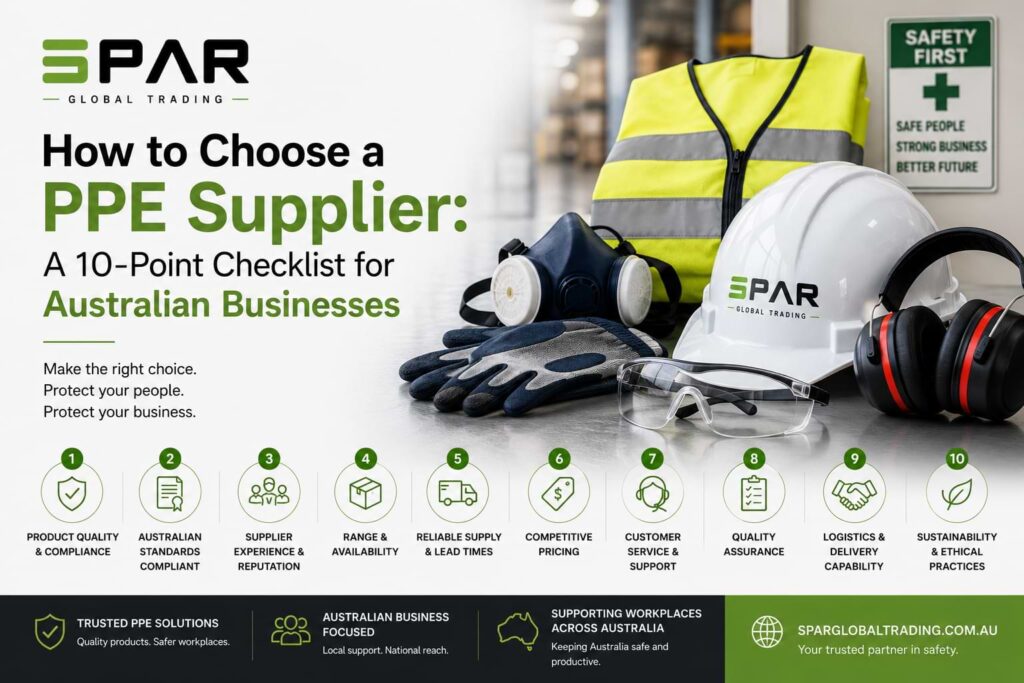
The 10-Point PPE Supplier Checklist
1. Specification matching. Everything starts with a written specification: the product, materials, sizes, markings, and the standards relevant to your industry and use case. A capable supplier sources against that document rather than steering you toward whatever stock they hold, and a good partner will help you tighten a loose specification before quoting, not after delivery.
2. Documentation and test reports. Ask exactly what paperwork travels with the goods: test reports from recognised laboratories, technical data sheets, and inspection records against your specification. Be wary of blanket “fully certified” claims offered without documents. The credible position is always documented conformity to the standards you named, not a certificate that supposedly covers everything.
3. Sampling before bulk. Physical samples, approved in hand, before production begins. The approved sample then becomes the contractual benchmark for the entire order, which turns a vague promise of quality into something you can measure a delivery against.
4. Pre-shipment inspection. The goods should be inspected against the approved sample and specification before they leave the factory: materials, stitching, sizing, markings, and packaging. Problems found at origin cost days; problems found on your loading dock cost the order.
5. Production capacity and consistency. One good batch is easy. Ask whether the supplier can hold the same quality at your volume, and across repeat orders, because batch-to-batch drift is one of the quietest failure modes in PPE supply.
6. Realistic lead times. Honest suppliers quote timelines that include production and sea freight, with buffer for peak seasons. A quote dramatically faster than every other is not efficiency; it is a promise being made by the sales side that the production side has not heard about.
7. Logistics capability. Who books the freight, clears customs, and prepares the import documentation, and at what point does responsibility transfer to you? Clear terms and a supplier who manages the chain to your door remove an entire category of first-time importer pain.
8. Communication and a single point of contact. You want one accountable person, reachable in a workable timezone, who answers hard questions quickly. Judge this during quoting: how a supplier communicates before your deposit is the best behaviour you will ever see from them.
9. After-sales accountability. Ask, in advance, what happens if delivered goods do not match the approved sample: the claims process, replacement terms, and timelines. The difference between a partner and a listing is what exists for you on the day something is wrong.
10. Transparent pricing. Insist on the landed cost to your door and a clear statement of what it includes: inspection, freight, documentation, delivery. An ex-factory price with everything excluded is not a lower price; it is a longer invoice arriving in instalments.
Red Flags to Walk Away From
Some signals end the conversation on their own. Walk away when you see:
- “Everything is certified” with nothing to show, or documents promised only after payment
- Resistance to pre-shipment inspection, which tells you what an inspection would find
- Photos instead of physical samples, for a product whose whole value is physical
- A price far below every other quote, because in PPE, someone always pays the difference
- Vagueness about where goods are actually made, or factory details that change between conversations
- Full payment upfront with no protection, especially on a first order
- Slow, evasive answers during the sales phase, since it only gets worse after the deposit lands
Questions to Ask Before Your First Order
| Question | What the answer tells you |
|---|---|
| “Can you source and supply against this written specification?” | Whether they work to your standard or push their stock |
| “What test reports and documents will accompany the shipment?” | Their documentation culture, before you depend on it |
| “Can I approve a physical sample before production?” | Their confidence in their own product |
| “Who inspects the goods before shipping, and against what benchmark?” | Whether quality control is a process or a sentence on a website |
| “What is the landed cost to my door, and what exactly does it include?” | Pricing transparency and hidden-cost risk |
| “What happens if the delivered goods don’t match the approved sample?” | The accountability you will have when it matters |
A disciplined supplier answers all six quickly and in writing. Hesitation on any of them is data.
How End-to-End Sourcing De-Risks PPE Procurement
You may have noticed that the ten checks describe a process as much as a supplier. That is deliberate, because it is exactly the process we run.
At SPAR, PPE procurement moves through five accountable stages. We source against your written specification through vetted manufacturing relationships. We customise where required, from sizing breakdowns to logo application on workwear. We quality check every order, inspected against your specification and required standards before anything ships. We ship, managing freight, customs, and documentation. And we deliver, with a single Australian-facing point of contact who owns the outcome.
Note the wording of that quality stage, because it reflects how responsible PPE sourcing actually works: goods sourced and inspected against your specification and required standards, evidenced by documentation, rather than blanket certification claims. It is the standard we hold ourselves to across our PPE and safety wear range, and the same discipline behind why businesses partner with us across every category.
One honest note: no partner removes your need for a clear specification. What a good partner removes is every gap between that specification and the goods on your dock. You can see the full process from brief to delivery on our how we work page.
Questions Procurement Teams Ask About PPE Sourcing
“How do I know if PPE meets Australian requirements?” Start by defining the standards that apply to your industry and use case in your specification, with guidance from your safety adviser or regulator resources if needed. Then require test reports and inspection records demonstrating conformity to that specification, rather than accepting general certification claims.
“Is it cheaper to buy PPE direct from an overseas factory?” The ex-factory sticker is lower, but the landed cost plus the risk you absorb usually is not. You take on vetting, quality control, freight, customs, and recourse yourself, and on safety-critical stock that trade rarely pays.
“What should a PPE specification include?” The product and its materials, sizes and quantities, the standards applicable to your use, required markings, packaging, documentation requirements, and delivery terms. If that list feels daunting, a sourcing partner can help you build it before quoting.
“How long does bulk PPE take to arrive in Australia?” Allow for production time plus sea freight, which together typically run a matter of months rather than weeks. The honest answer is order-specific, and a committed timeline should be stated in your quote before you pay anything.
“Do I need inspection on every shipment, even repeat orders?” Yes. Inspection against the approved sample protects every order, and repeat orders most of all, because consistency drift creeps in quietly between batches.
Ready to compare properly? Send your PPE specification for a sourcing quote, and we will come back with options, documentation, and a delivered cost you can hold us to.