

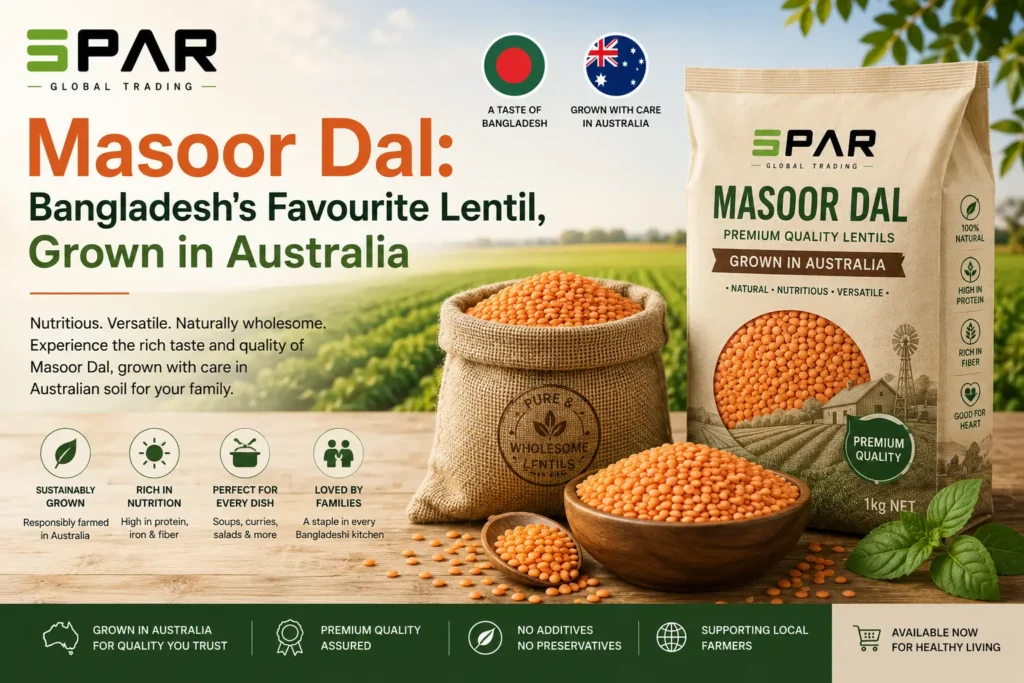
Masoor dal is the split red lentil, known in English simply as red lentils. It is the everyday dal of Bangladesh and much of South Asia. Here is the surprise: most of it is not grown there. Australia is the world’s second largest lentil exporter and Bangladesh’s biggest supplier, shipping hundreds of thousands of tonnes of red lentils every year.
The story in numbers:
- Around 25g of protein per 100g of dry lentils, which is why masoor anchors everyday nutrition across South Asia
- 15-20 minutes to cook, no soaking needed, making it the fastest dal in the kitchen
- Australia grows roughly 1 to 1.8 million tonnes of lentils in recent seasons, overwhelmingly red varieties, and almost all of it is exported
- Australia is the world’s second largest lentil exporter, behind only Canada
- Australia is Bangladesh’s largest lentil supplier, providing the majority of the country’s lentil imports; in a recent season, around 335,000 tonnes of Australian lentils shipped to Bangladesh
- Harvest runs November to December, so fresh Australian crop arrives counter-seasonally, right when subcontinental supplies run between harvests
We know this journey first-hand, because carrying Australian lentils to South Asia is half of our business. Here is the full story, from what masoor dal actually is to how it crosses the ocean.
What Is Masoor Dal? (And What It’s Called in English)
Masoor (মসুর) is the red lentil, a seed of the lentil plant Lens culinaris. “Dal” does double duty in South Asian kitchens: it means a split pulse, and it also names the simmered dish made from one. So masoor dal is the split red lentil, and also the soupy comfort food it becomes.
In English, masoor dal is simply called red lentils or split red lentils. If a recipe calls for red lentils, masoor dal is what it means.
The colour trick confuses many first-time cooks. On the plant, the whole lentil wears a dull brownish seed coat. Split it and remove the skin, and the inside glows salmon-orange. Cook it, and it softens toward gold.
| Form | Appearance | Cooking behaviour | Best for |
|---|---|---|---|
| Whole masoor (sabut) | Small, flat, brownish skin | Holds shape; 25-35 minutes | Hearty dals, sprouting, salads |
| Masoor dal (split, skinned) | Bright orange-red | Melts creamy; 15-20 minutes | Everyday dal, soups, khichuri, purees |
Split masoor’s speed is its superpower. It needs no soaking, collapses into a silky consistency, and takes on garlic, turmeric, and a finishing tempering of spices better than almost any other pulse.
Why Masoor Is the Staple of Bangladesh and South Asia
Ask what Bangladesh eats on an ordinary day and the answer is two words: dal-bhat, lentils and rice. It is the meal that anchors the table across the country, from village kitchens to Dhaka canteens, and masoor is the dal most likely to be in the pot.
The reasons are practical and affectionate at once. Masoor is affordable protein in a country where fish and meat are not everyday certainties for everyone. It cooks fast on any stove. And it is endlessly adaptable: thin and brothy patla dal ladled over rice, thick dal with lime and green chilli, khichuri when the rains come, and piyaju, the crisp lentil fritters that define iftar tables in Ramadan.
Multiply that daily bowl across hundreds of millions of people in Bangladesh, India, Nepal, Sri Lanka, and Pakistan, and masoor becomes one of the most consumed foods on earth. Which raises a question few of those diners ever ask: where does all of it actually come from?
The Surprise: Where the World’s Masoor Actually Grows
Bangladesh does grow lentils, and local masoor is prized. But domestic production covers only a modest share of what the country eats, and the gap between harvest and appetite has widened for decades. Bangladesh is one of the world’s major lentil importers as a result.
Globally, lentil growing is remarkably concentrated. Canada, Australia, and India together account for around 70 percent of world production, and the export trade is dominated by just two of them: Canada first, Australia second.
For Bangladesh specifically, the answer is clearer still. Australia is the country’s largest lentil supplier, providing the majority of its imports, with hundreds of thousands of tonnes arriving in a typical year.
So here is the quiet truth behind one of the world’s most familiar meals: the masoor simmering in a Dhaka kitchen tonight quite likely began its life in a paddock in South Australia. Bright red Australian lentils have become an everyday ingredient of Bangladeshi life, largely without anyone at the table knowing it.
Why Australian Conditions Suit Red Lentils
It seems improbable that a South Asian staple thrives on the far side of the equator, until you look at what a lentil plant actually wants.
Lentils are a cool-season crop that likes a mild, moist growing period and a warm, dry finish. Southern Australia’s Mediterranean-style climate delivers exactly that. The crop is sown into autumn and winter rainfall across South Australia’s Yorke Peninsula, Mid North, and Mallee, and Victoria’s Wimmera and Mallee, then ripens into a dry spring. That dry finish matters enormously: it produces clean, bright, uniform grain with low disease pressure, the qualities millers pay for.
Lentils also earn their place in the farming system itself. Grown in rotation with wheat and barley, they fix nitrogen into the soil, so Australian growers have expanded plantings dramatically over the past decade.
Then there is timing. Australia harvests in November and December, the mirror image of northern hemisphere crops. Fresh Australian lentils reach South Asia counter-seasonally, precisely when the previous year’s supplies are running down.
And one detail we love, because it shows how deliberately this trade works: the industry grows to Bangladesh’s taste. Bangladeshi buyers prefer plump, rounded red lentils known in the trade as football lentils, and Australian varieties and export specifications have been matched to exactly that preference. This is not a country offloading surplus grain. It is a supply chain grown to order.
From Australian Farm to South Asian Table: The Export Journey
Follow one shipment and the two-way trade story comes alive.
It starts at harvest, as headers strip the crop into field bins under a hot November sky. The lentils move into receival and storage, where they are kept cool, dry, and insect-free.
Next comes the transformation into a food-grade export. The grain is cleaned of stalk, stone, and admixture, then graded for size and colour to the buyer’s specification. Depending on the order, it ships as whole red lentils for milling at destination, or is machine-split into masoor dal ready for the pot.
Then the paperwork that makes trust possible. Export lentils are fumigated, inspected, and documented under Australia’s quarantine and export system, the AQIS-documented process that certifies what is in every bag. Packed into 25 or 50 kilogram bags or bulk containers, the shipment is sealed and manifested.
The ocean leg runs from Australian ports to Chattogram, where the containers clear customs and move to mills and wholesale markets. From there the lentils fan out through bazars across the country, into kitchens, into the evening pot, into dal-bhat.
That entire chain, from paddock to port to port to plate, is the export half of what SPAR manages. Grain-grade cleaned, fumigated, and AQIS-documented red and green lentils, chickpeas, and faba beans are the core of our Australian lentils and pulses offer.
Sourcing Australian Red Lentils in Bulk
If you are an importer, miller, or wholesaler in Bangladesh or elsewhere in South Asia, the practical questions are specification, documentation, and reliability. That is our job.
We source Australian red lentils to your requirement, whole or split, sized and graded to market preference, including football-type specifications for the Bangladesh trade. Every shipment moves with full export documentation, and we manage the freight and logistics through to destination port.
There is a pleasing symmetry to it. The same two-way trade relationships that carry Bangladeshi jute to Australian shelves carry Australian lentils to Bangladeshi tables. Goods move in both directions, and both directions feed something worth keeping: one a bag, the other a bowl. For the full picture of what Australia grows beyond red lentils, see our exporter’s guide to the types of lentils and pulses grown in Australia.
Questions People Ask About Masoor Dal
“What is masoor dal called in English?”
Red lentils, or split red lentils. Whole masoor with the skin on is sold as whole red or brown lentils.
“Is masoor dal the same as red lentils?”
Yes. Masoor is the lentil, and masoor dal is the split, skinned form that cooks orange and creamy.
“Where does masoor dal come from today?”
The plant was first domesticated in the ancient Near East, but today’s supply is grown mainly in Canada and Australia, with India also a major producer. Bangladesh imports most of its masoor, the majority of it from Australia.
“Why does Bangladesh import lentils from Australia?”
Domestic production covers only part of national demand, and Australian red lentils arrive fresh, clean, and uniform at counter-seasonal timing. Australia has become Bangladesh’s largest lentil supplier as a result.
“What are football lentils?”
A trade name for plump, rounded red lentil types preferred by Bangladeshi buyers. Australian growers and exporters supply football-spec lentils matched to that market.
Importers and wholesalers: request an export quote for Australian red lentils, whole or split, documented and delivered to specification.