

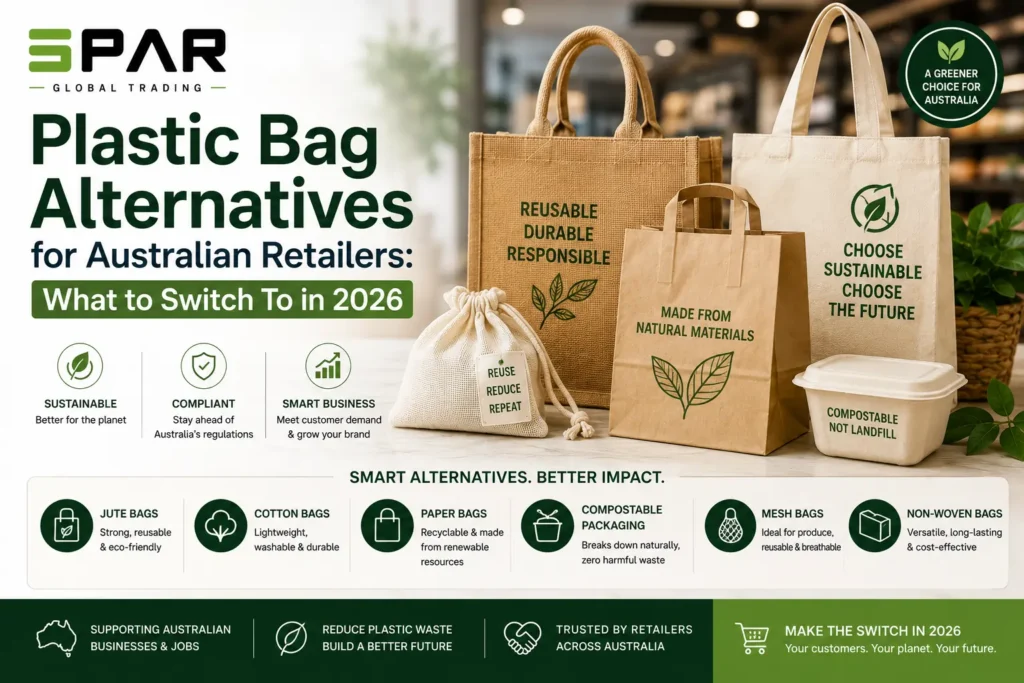
The best plastic bag alternatives for Australian retailers in 2026 are jute bags, cotton and canvas totes, paper bags, and non-woven PP bags. Jute and cotton deliver the strongest mix of durability, branding value, and sustainability. Paper suits low-cost transactional use, while non-woven PP is cheap but still plastic.
Where the rules stand as of mid-2026:
- Lightweight single-use plastic shopping bags are banned in every Australian state and territory, typically covering bags under about 35 microns
- WA and SA have gone further, banning thicker plastic carry bags as well
- Queensland allows heavyweight plastic bags only under strict conditions, including minimum recycled content and verified durability
- NSW and Victoria still permit heavier reusable plastic bags, but the national trend is clearly toward tighter restriction, with federal packaging reform pushing for harmonised standards
- Penalties are real: supplying banned plastics can attract fines reaching tens of thousands of dollars for commercial operators
- An estimated 180 million plastic bags still enter the Australian environment every year
Regulations continue to evolve state by state, so always confirm current requirements with your state regulator before placing a large order. What follows is the practical part: which alternative to choose, and why.
Why Retailers Are Switching: Regulation Plus Customer Expectation
Two forces are driving the change, and only one of them is the law.
The regulatory force is momentum. Many retailers responded to the first bans by moving to thicker “department store” plastic bags, which remain legal in some states. In 2026 that looks like a short-term play: WA and SA have already closed that path, Queensland has attached strict conditions to it, and federal reform is working to harmonise the patchwork. Stock that is legal today may be dead stock after the next amendment.
The commercial force is your customer. The bag you hand over at the till is one of the most visible sustainability signals your business sends, and shoppers have learned to read it. A plastic bag now says something about a brand, and it is rarely something good.
That is why the smartest retailers treat this switch as an upgrade rather than a compliance cost. Done well, the replacement bag is not just legal. It is a marketing asset your customer keeps.
The Main Alternatives Compared
| Option | Upfront cost | Realistic reuse | Branding potential | Sustainability story | Watch-outs |
|---|---|---|---|---|---|
| Jute bags | Mid | Hundreds of uses over years | Strong; bold logos on a fabric that signals eco at a glance | Excellent; fast-growing, rain-fed, biodegradable | Spot clean only; bold artwork prints best |
| Cotton and canvas totes | Mid | High; washable and foldable | Excellent; finest print detail and full colour | Good, especially organic; cotton farming is input-heavy | Light cotton sags under heavy loads |
| Paper bags | Low | Often 1-3 uses | Modest; prints well but rarely survives long | Recyclable and compostable, but weak per-use footprint | Fails in rain; handles tear; plastic-laminated paper can be restricted in the strictest states |
| Non-woven PP “green bags” | Low | Moderate | Limited; reads as cheap and generic | Weak; it is still plastic and never biodegrades | Sheds plastic as it wears; increasingly off-brand for eco positioning |
Here is the honest read on each.
Jute bags
Jute is the alternative that does the most jobs at once. The stiff natural weave stands upright, carries serious weight, and lasts 3-4 years or more in regular use, which is why it has become the default for grocers, hampers, markets, and eco-led retail. Its golden texture communicates sustainability before a customer reads a word, and the fibre grows in months on monsoon rain and biodegrades cleanly at end of life. You can see the formats, sizes, and print options across our jute and cotton bags range.
Cotton and canvas totes
Cotton is the branding surface. It takes fine detail and full-colour artwork better than any other option here, folds small enough to live in a handbag, and machine washes for a long service life. Canvas, its heavyweight sibling, turns the same fibre into premium merch that survives daily use for years. The trade-off is agricultural: conventional cotton is water and pesticide intensive, so it needs a long life of reuse to earn its footprint. We compare the fabrics in detail in our jute vs cotton vs canvas guide.
Paper bags
Paper is the transactional workhorse: cheap, compliant everywhere, recyclable, and fine for a single carry home. Its weaknesses are the wet Tuesday and the torn handle. Because most paper bags manage only a handful of uses, their per-use footprint is worse than it looks, and in the strictest states even plastic-laminated paper bags can fall under restrictions. Use paper where reuse was never realistic, not as your flagship bag.
Non-woven PP bags
This one deserves the most honesty, because the nickname “green bag” hides the material. Non-woven polypropylene is plastic. It is cheap, moderately durable, and legal, but it sheds plastic as it wears and never biodegrades. For a brand making a public switch away from plastic bags, replacing plastic with different plastic is a story that falls apart the moment a customer asks about it.
Cost Per Use: The Metric That Matters
Comparing bags on unit price is the mistake that makes plastic look cheap and quality look expensive. The number that matters is cost per use: the unit price divided by the number of times the bag is realistically used.
Run that maths and the table flips. A paper bag with a low unit price but 2 uses costs more per carry than a jute bag at several times the price that serves a customer for 3 years. The plastic bag it all replaces was only ever cheap because someone else, and eventually the environment, absorbed its real cost.
Three things determine whether a bag achieves its potential uses:
- Durability: stitching, handles, and fabric weight decide whether the bag survives long enough to pay itself off
- Keepability: a bag customers find attractive and useful gets reused; a flimsy afterthought gets binned
- Fit for purpose: a grocer needs structure and load strength, a boutique needs fold-flat elegance, and mismatches get abandoned
Cost per use also has a marketing twin: impressions per bag. Which brings us to branding.
Branding Potential: The Mobile Billboard Test
Every reusable bag your customer keeps is advertising you did not have to buy twice. A kept bag travels to markets, offices, gyms, and school pick-ups, putting your logo in front of strangers for years. A binned bag advertises nothing.
This is the thinking behind our own line: your brand, on a bag worth keeping. Judged as media, the options rank clearly. Jute delivers bold, high-visibility branding on a fabric whose texture itself endorses your values. Cotton and canvas carry the most detailed artwork for design-led brands. Paper prints nicely but retires within days, and non-woven PP tends to look like what it costs.
Match the artwork to the fabric: bold one or two colour logos suit jute’s weave, while fine detail belongs on cotton. We cover print methods, artwork setup, and minimum quantities in our custom printed jute bags buyer’s guide.
What Charities and Eco Brands Are Choosing
The organisations with the least room for greenwash have largely converged on the same answers, and their logic is useful for any retailer.
Charities lean on cotton and jute totes as merchandise and event bags, because a bag supporters actually carry keeps the cause visible for years. Eco-led brands and grocers favour unlaminated jute in natural finish, keeping the product fully biodegradable and the story clean. Premium retail and hospitality brands increasingly split the difference: jute or canvas as the flagship keeper bag, with recycled-content paper for quick transactional carries.
The common thread is that none of them chose the cheapest option. They chose the option their customers would keep.
Making the Switch Without Supply Headaches
Most switching pain is procurement pain, and it is avoidable. Before you order:
- Confirm your state’s current rules with the regulator, especially if you trade across state lines where requirements differ
- Choose by use case, not by a single bag: a till bag, a promo bag, and a premium bag can be different materials
- Sample before committing, because fabric weight, handles, and print quality can only be judged in hand
- Order to realistic demand, since over-ordering undermines both budget and sustainability claims
- Plan lead times around deadlines, allowing for production and sea freight rather than scrambling at a ban date
- Use one accountable partner rather than juggling a factory, a printer, an inspector, and a freight agent
That last point is our whole model. At SPAR we source from trusted makers, customise the printing and packaging to your brand, inspect before anything ships, and manage freight, customs, and documentation through to delivery in Australia. You can see exactly how we work from brief to delivery.
Questions Retailers Ask About the Switch
“Are thick plastic bags still legal in Australia?” It depends on the state as of mid-2026. WA and SA have banned them, Queensland permits them only with high recycled content and proven durability, and NSW and Victoria still allow heavier reusable plastic bags. The direction everywhere is toward restriction, so check your state regulator before relying on them.
“What is the cheapest compliant option?” Paper has the lowest unit price and non-woven PP the lowest price among reusables. On cost per use, jute and cotton usually win because they survive hundreds of carries.
“Are non-woven green bags actually eco-friendly?” Not really. They are polypropylene plastic, so they never biodegrade and shed plastic as they age. They comply with the bans, but they do not tell a sustainability story.
“What should a grocer choose compared with a fashion retailer?” Grocers need structure and load strength, which points to jute. Fashion and design-led retailers need print fidelity and a soft fold, which points to cotton or canvas. Many businesses run both for different moments.
“Do paper bags ever fall under the plastic rules?” Plain paper bags do not, but paper bags with plastic laminate linings can be caught in the strictest states. If you use laminated luxury-style paper bags, verify the rules in every state you trade in.
Ready to replace plastic with a bag your customers keep? Explore our eco-friendly bags or request a quote and we will match the right mix to your stores.