

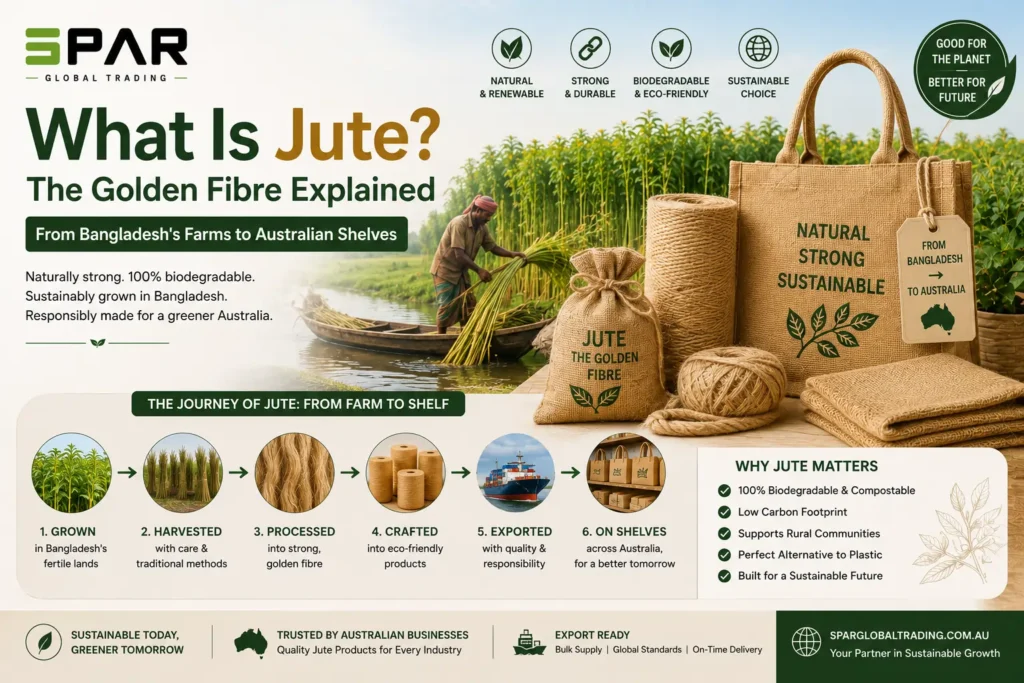
Jute is a natural plant fibre long, strong, and golden in colour spun from the stems of the jute plant. After cotton, it is the most widely produced natural fibre on earth, and the overwhelming majority of it begins life in one place: the great river delta of Bangladesh and eastern India. From there, it travels a remarkable path. Cut by hand, softened in slow-moving water, stripped, sun-dried, spun and woven, jute eventually arrives on Australian shelves as shopping bags, storage baskets, rugs, and sustainable packaging.
At SPAR Global Trading, jute is not an abstract commodity on a price sheet. It is a fibre we source directly from trusted makers in Bangladesh and deliver into the hands of Australian businesses, retailers, and brands. This guide explains what jute is, what it’s made of, where it comes from, how it’s processed, and why it has carried the name “the golden fibre” for more than a century.
What Is Jute Made Of?
Jute is what botanists call a bast fibre, meaning it comes from the inner bark of the plant’s stem not from a seed boll like cotton, or a leaf like sisal. Two closely related species supply nearly all of the world’s jute: Corchorus capsularis, known as white jute, and Corchorus olitorius, known as tossa jute, which is generally prized for its softer, silkier, and stronger fibre. If you have ever eaten molokhia, the leafy green beloved in Egyptian and Middle Eastern cooking, you have eaten the leaves of the tossa jute plant a reminder of how little of this crop goes to waste.
Chemically, jute is a lignocellulosic fibre. It is composed mostly of cellulose, the structural substance found in all plants, bound together with lignin, the woody polymer that gives jute its distinctive strength and slightly coarse, rustic texture. This natural composition explains jute’s two defining qualities: it is tough enough to carry serious weight, and it is completely biodegradable at the end of its working life.
The fibres themselves are extraordinary. A single strand of jute can run from one to four metres long exceptionally long for a natural fibre with a soft sheen that catches the light. Woven into cloth, jute becomes hessian (called burlap in North America), the sturdy, breathable fabric found in everything from coffee sacks to designer tote bags.
Where Does Jute Come From?
Ask where jute comes from and the answer is unusually concentrated. Bangladesh and the neighbouring Indian state of West Bengal the lands of the Ganges–Brahmaputra delta grow the vast majority of the world’s jute. India produces the largest volume overall but uses most of it at home, while Bangladesh stands as the world’s leading exporter of raw jute fibre and a global centre of jute manufacturing.
This concentration is no accident. Jute is a demanding crop with very particular tastes. It thrives on warm temperatures, high humidity, generous monsoon rainfall, and the deep, soft alluvial soil that the delta’s rivers deposit fresh every year. Few places on earth offer all of these conditions together, and the Bengal delta offers them in abundance. The same rivers that feed the crop also provide the slow-moving water needed to process it a detail that matters enormously, as we’ll see shortly.
The plants themselves are striking. Sown as the monsoon season begins, jute shoots up like a green wall, reaching two and a half to three and a half metres in roughly four months. A mature jute field looks less like a crop and more like a young forest.
For SPAR, this geography is the foundation of the business. Our two-way trade model exists precisely to connect this region its farmers, spinners, weavers, and artisans with Australian businesses that want sustainable products with a genuine story behind them.
Why Is Jute Called the Golden Fibre?
There are two answers: one you can see, and one written into history.
The first is simple. Freshly processed jute has a warm, golden lustre. Bundled and drying in the sun along village roads in Bangladesh, it genuinely gleams long silken strands the colour of ripe wheat.
The second answer is economic. For generations, jute was the backbone of Bengal’s economy. In the nineteenth and twentieth centuries it clothed global trade, sacking everything from Brazilian coffee to Australian wool, and it built entire industrial cities on both sides of the world from the mills of Kolkata to Dundee in Scotland, a city so transformed by the trade that it became known as Juteopolis. In Bangladesh, jute earned the name shonali aansh literally, “golden fibre” because it was for decades the country’s most valuable export, funding schools, infrastructure, and millions of rural livelihoods.
That heritage is part of why our own tagline describes SPAR as the golden thread between Australian business and Asian manufacturing. The phrase is not just a metaphor. It is a nod to the fibre that first connected this region to the world and still does.
How Jute Is Harvested and Processed
One of the most compelling things about jute is how human its production remains. The journey from seed to fabric has changed surprisingly little in a hundred years, and much of it still happens by hand.
It begins with sowing, typically between March and May as the monsoon builds. Around four months later, the crop is ready. Harvesting is done by hand with sickles, ideally when the plants are at the flowering stage the point at which fibre strength and fineness are at their best. The cut stalks are tied into bundles and left briefly in the field before the most distinctive step of all: retting.
Retting is a kind of controlled, natural fermentation. The bundled stalks are submerged in ponds, canals, or slow-moving streams for ten to twenty days, where water and naturally occurring microbes dissolve the pectin that glues the fibre to the woody core of the stem. Get the retting right and the fibre comes away soft, strong, and lustrous; get it wrong and quality suffers which is why generations of accumulated local expertise matter so much.
Next comes stripping, done standing waist-deep in water: workers peel the long fibres from each stalk by hand, wash them clean, and hang them to dry in the sun. The dried fibre is graded, pressed into bales, and sent onward to mills and workshops. There it is spun into yarn and woven into hessian cloth, sewn into bags, or in the case of the handcrafted storage baskets and rugs that Australian homes have fallen for braided and shaped by skilled artisans, piece by piece.
Even the leftovers work hard. The woody sticks left after stripping are used across rural Bangladesh for cooking fuel and fencing. Very little of a jute plant is ever thrown away.
What Is Jute Used For?
Jute’s combination of strength, texture, and biodegradability has given it a remarkably broad life. In Australia, you are most likely to meet it in four forms.
The first is bags. Reusable jute shopping bags, promotional totes, and custom-printed retail bags have become the natural successor to single-use plastic durable enough for years of use, with a natural-fibre look that customers instinctively read as sustainable. This is the heart of SPAR’s jute and cotton bag range, where the fabric doubles as a branding surface: every printed bag is a small, mobile billboard for the business that hands it over.
The second is home décor. Handwoven jute storage baskets, round jute rugs, and planters bring warmth and texture to interiors, and their handmade character means no two pieces are quite identical.
The third is packaging and sacking the fibre’s original trade. Hessian sacks still carry coffee, grain, potatoes, and produce around the world because they are strong, breathable, and reusable.
And the fourth is the quiet, industrial end of the spectrum: twine and rope, garden ties, carpet backing, and geotextiles — open-weave jute matting laid over embankments to control erosion while vegetation establishes, after which the fabric simply biodegrades into the soil.
Is Jute Sustainable? A Quick Look
Jute has a strong environmental story, and it is worth telling honestly. The crop matures in around four to six months, making it one of the fastest-renewing fibres in the world. It is grown largely on monsoon rain rather than irrigation, needs comparatively little in the way of pesticides or fertiliser, and absorbs carbon dioxide rapidly while it grows. At the end of its life, a natural jute product biodegrades back into the soil rather than persisting for centuries the way plastic does.
Like any material, though, the full picture depends on how a product is made dyes, linings, and freight all play a part, and sourcing choices matter. We take a deeper, franker look at those questions in our companion guide on whether jute bags are truly eco-friendly. The short version: jute earns its reputation, and it earns it best when it is sourced well. That principle sits behind everything in our promise of smart sourcing and sustainable solutions.
From Bangladesh’s Fields to Australian Shelves: How SPAR Sources Jute
Everything described above the delta soil, the hand harvesting, the retting ponds, the weaving sheds sits at one end of a supply chain. Australian businesses sit at the other. SPAR Global Trading exists to close that distance properly.
We work directly with trusted jute makers in Bangladesh, selected and vetted through on-the-ground relationships rather than online directories. From there, our end-to-end model takes over: we match the right product to your quality, budget, and compliance needs; customise it with your logo printing, sizing, and packaging; inspect the goods before anything ships; and manage the freight, customs, and documentation until delivery in Australia. Sourced, customised, delivered with a single point of contact throughout.
And because our trade runs both ways, the relationships that bring golden fibre to Australia are the same ones that carry Australian lentils and pulses back to South Asia. It is one connected loop the golden thread, working in both directions.
Ready to put the golden fibre to work for your brand?
Explore our eco-friendly jute bags or request a sourcing quote today.